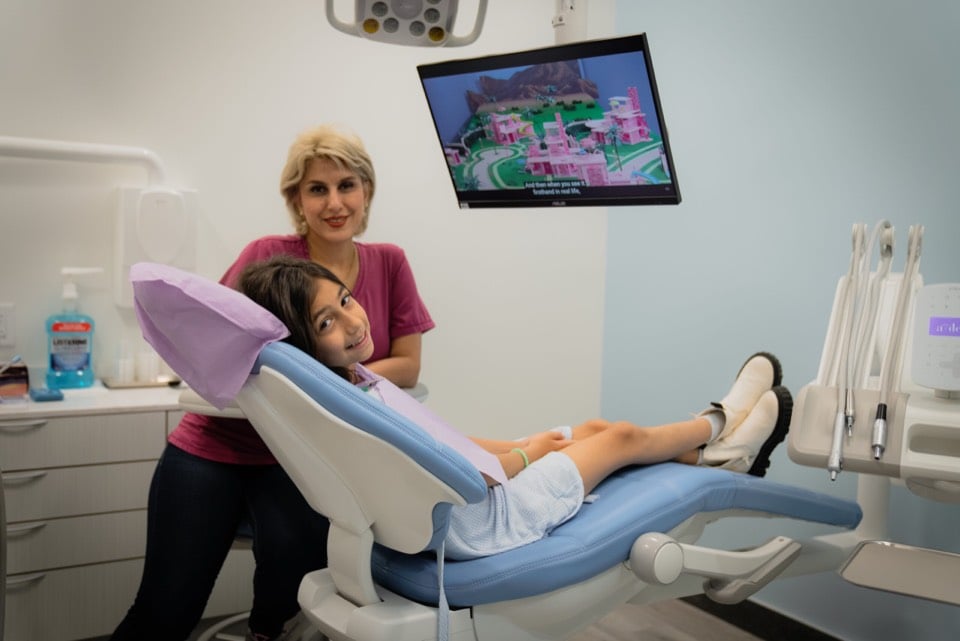
A 12-year-old girl came to Hastings Dental Studio with a toothache. It was her first visit to any dentist, she was scared, and her family had no dental insurance. She left the clinic smiling, her treatment that day cost the family nothing, and her parents left with a plan to apply for the Canadian Dental Care Plan (CDCP) so she can come back for the rest of her care.
We are sharing her story, with her identity kept private, because many families in Vancouver are in the same position: a child in pain, a new country, no coverage, and no idea what a dental visit will feel like or cost.
What happened at her first visit
She arrived nervous and unsure what to expect. Our dental assistants stayed with her, reassured her, and supported her through each part of the appointment. By the end she had tolerated treatment well and was in good spirits.
The exam showed deep decay (caries) close to the pulp, the soft tissue in the centre of the tooth that holds its nerve and blood supply. Decay that deep can mean the tooth will need root canal treatment, but that depends on further assessment.
Her parents told us they had no dental coverage, so we treated her at no charge. We advised them to apply for the CDCP and bring her back for reassessment and definitive treatment once coverage is in place. We also asked them to come back sooner if her pain continues or gets worse.
How do dentists help a child with dental anxiety?
Most anxious children can get through treatment with calm explanation, a slower pace, and steady support from the dental team. Fear of the dentist is common in kids. One review estimates it affects about 9% of children and teens in Canada, the US, Australia and Europe, and a child who has never seen a dentist before has every reason to feel unsure.
The American Academy of Pediatric Dentistry lists several basic behaviour guidance techniques that dental teams use with children, including:
- Tell-show-do: explain a step in simple words, show the instrument, then do it.
- Ask-tell-ask: check how the child feels, explain, then check again.
- Positive reinforcement and praise for each thing the child manages.
- Distraction, such as conversation or something to watch.
The same guidance lists nitrous oxide (laughing gas) as an option for anxious patients when talking and pacing are not enough. In the AAPD’s 2023 clinical guideline, strategies such as positive reinforcement, breathing relaxation, combined tell-show-do and audiovisual distraction showed large reductions in anxiety for children having dental treatment.
What parents can do before the visit
- Tell us about your child’s fears when you book, and whether this is their first dental visit.
- Talk about the visit at home in simple, calm words: someone will count and look at your child’s teeth and explain each step first.
- If your child speaks another language more comfortably, let us know, and bring someone who can help translate if you need to.
- Keep up regular checkups once the urgent problem is fixed. A study of 575 school children found that starting dental visits early and going regularly were both linked to lower dental fear.
Does a deep cavity near the nerve mean a root canal?
Not always, which is why this patient’s root canal is still “possible” rather than certain. When decay reaches close to the pulp, the pulp may settle down once the decay is removed and the tooth is sealed, or it may stay inflamed or become infected. Only a follow-up exam and testing can tell which way it is going.
If the pulp is inflamed or infected, a root canal removes it, cleans and shapes the inside of the root, then fills and seals the space. The American Association of Endodontists lists sensitivity to hot or cold that lingers after the food or drink is gone as one of the signs that a tooth may need this treatment.
When to bring your child back sooner
Call us before the planned follow-up if:
- the toothache continues or gets worse
- hot or cold drinks cause pain that lingers
- the gum near the tooth swells, or a bump appears on it
- your child’s face swells or they have a fever (call the same day)
Waiting for insurance should never mean waiting out worsening pain. If things change, phone the clinic and we will work out next steps with you.
How can families without dental insurance get help through the CDCP?
The Canadian Dental Care Plan is a federal program that pays some or all of the cost of dental care for residents with no access to private dental insurance and an adjusted family net income under $90,000. Applications are open for the 2026-2027 benefit period, and it costs nothing to apply.
Who qualifies for the Canadian Dental Care Plan?
You must meet all four requirements:
- No access to private dental insurance, including through your work, a family member’s work, a pension plan, or a plan you bought. Having coverage you never use or chose not to enrol in still counts as access.
- You filed your tax return in Canada for the previous year. A spouse or common-law partner must also have filed.
- Your adjusted family net income is under $90,000.
- You are a Canadian resident for tax purposes, and so is your spouse or partner.
For newcomer families, the tax return is often the step that gets missed. If you arrived recently and have not yet filed a Canadian return, filing comes first.
What does the CDCP cover for a child with a deep cavity?
The services listed by the government include exams and x-rays, fillings, pain control for diseased teeth, root canal treatments and procedures to reduce infection and relieve pain. For anxious patients, the plan also lists nitrous oxide and oral sedation; deeper sedation needs approval in advance.
How much the plan pays depends on your adjusted family net income:
| Adjusted family net income |
CDCP pays (at CDCP fees) |
You pay (at CDCP fees) |
| Under $70,000 |
100% |
0% |
| $70,000 to $79,999 |
60% |
40% |
| $80,000 to $89,999 |
40% |
60% |
Source: Canada.ca, What services are covered. A dental office’s fees can be higher than the CDCP fee schedule, so ask about any extra charges before treatment starts.
How do I apply for the CDCP for my child?
You can apply online through My Service Canada Account, through the Canada.ca application, or by phone at 1-833-537-4342 (TTY 1-833-677-6262). For each person applying you will need:
- full name and date of birth
- Social Insurance Number (for children, if they have one)
- home and mailing address
- any dental coverage from a government social program
A spouse or partner who also wants coverage must submit their own application. A friend, relative, translator or interpreter can help you apply as long as you give clear consent. The government also publishes CDCP fact sheets in several languages. Be wary of anyone who asks for a fee or banking details to sign you up; the official application is free.
What happens after you apply?
You will get a letter or email confirming whether you are enrolled, with your member ID, co-payment level and coverage start date. Only care received on or after that start date is covered, so book your child’s follow-up for that date or later. You do not need to wait for the Sun Life member card to arrive; bring your member ID, start date, co-payment level and a piece of ID to the appointment.
Is there BC coverage for children too?
BC’s Healthy Kids Program helps lower-income families with up to $2,000 of basic dental services per child every two years, for families eligible for MSP supplementary benefits. The province says Healthy Kids can be combined with the CDCP. Ask us if you are not sure which program your child falls under.
Frequently asked questions
Can my child see a dentist in Vancouver without dental insurance?
Yes. You can book at Hastings Dental Studio without insurance. Call first so we can talk about your child’s needs and what the visit will cost before any treatment begins.
Can my teenager apply for the CDCP?
Children and teens under 18 are covered under a parent’s or guardian’s application, as long as the family meets the four eligibility requirements. There is no fee to apply.
Does the CDCP cover root canals for children?
Root canal treatments, pulpectomies (the first step of a root canal) and treatments to relieve pain and infection are on the government’s list of covered services. Your share depends on your family income and the clinic’s fees.
Does the CDCP cover sedation for anxious kids?
Nitrous oxide and oral sedation appear on the covered list. Conscious sedation, deep sedation and general anesthesia need approval from the plan before treatment.
Can I book a dental appointment as soon as I apply for the CDCP?
Wait for your enrolment letter, then book for your start date or later. Only care on or after your coverage start date is paid by the plan. If your child is in pain before then, call us anyway.
My child is terrified of the dentist. What should I tell the clinic?
Tell us when you book. Mention any past bad experience, what tends to calm your child, and which language they are most comfortable in. That lets our team plan a slower, gentler first visit.
Book a visit at Hastings Dental Studio
If your child has a toothache, or has never been to a dentist and you are worried about how they will cope, call us at (604) 416-5444 or request an appointment online. Ask us whether we can bill the CDCP directly for your child’s treatment, as the government recommends you confirm with any provider before booking.
Hastings Dental Studio, 2652 East Hastings St, Vancouver, BC V5K 1Z6. Open Monday 11:00 am to 4:00 pm, Tuesday, Wednesday and Friday 9:30 am to 5:30 pm, Thursday 11:00 am to 7:00 pm, and Saturday 9:30 am to 4:00 pm.