
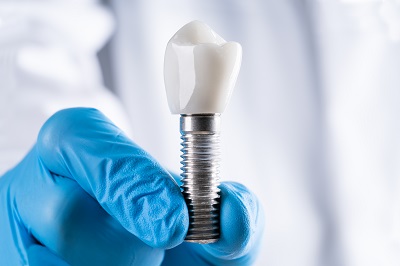
Missing a tooth changes how you chew on that side of your mouth without you noticing at first. Then it starts changing how you speak, how the neighboring teeth drift, and eventually how your jawbone holds its shape. Dental implants are the one replacement option built to stop that chain reaction at the root, literally, because the implant itself replaces the root and not just the visible tooth.
At Hastings Dental Centre in Vancouver, implants are one of the most requested procedures in the practice, and the questions patients bring in are almost always the same five or six. Here’s what we tell them.
What is a dental implant, exactly?
A dental implant is a titanium post placed directly into the jawbone, where it takes over the job your natural tooth root used to do. Once the bone fuses to it, a connector piece called an abutment holds a crown, bridge, or denture on top. The Canadian Dental Association describes it as an artificial root made of titanium metal, inserted into the jawbone to replace the root of the natural tooth, with a replacement tooth attached on top to anchor it in place.
Titanium is used because bone bonds to it. That bonding process is called osseointegration, and it’s the reason implants hold up in a way a denture glued to the gum never could.
How much does a dental implant cost in Vancouver?
For a single tooth, the price at Hastings Dental Center generally falls between $2,000 and $5,000 per implant, depending on the number of implants needed, the type of restoration (a crown versus an implant-supported bridge), and whether preparatory work like bone grafting is required. Patients are quoted a similar $3,000 to $5,000 range once the crown and abutment are factored in.
That lines up with what dental insurers report nationally. Canada Life puts the Canada-wide range at $1,000 to $6,000 per tooth depending on the provider, the patient’s situation, and location. Vancouver sits toward the middle to upper end of that range, which tracks with the cost of running a clinic in the city.
One thing worth flagging before you budget: if you’re counting on the federal Canadian Dental Care Plan to help cover an implant, it won’t. The CDCP dental benefits guide lists implants and ridge augmentation as explicit exclusions. Most private insurance plans also cap implant coverage well below the actual cost, so it’s worth calling your provider before your consultation, not after.
Are All-on-4 implants a more affordable way to replace several teeth?
If you’re missing most or all of your teeth in one arch, placing an individual implant under every tooth adds up fast. All-on-4 gets around that by anchoring a full arch of replacement teeth on just four strategically placed implants, which cuts down both the surgical cost and the number of implants you’re paying for.
It’s not a discount version of implants, it’s a different engineering approach. For patients in East Vancouver looking at full-mouth restoration, it’s usually the more realistic budget compared to individual implants placed across the whole arch. During a consultation, we’ll take a scan and tell you plainly whether your bone density and jaw shape make you a good fit for the four-implant approach or whether you’d need more support points.
How long does recovery actually take?
Plan on the full process, not just the surgery day. According to the Canadian Dental Association, the implant needs several months to bond with the bone before the permanent tooth goes on top, and in many cases the placement and the attachment of the abutment happen as two separate stages. Hastings Dental Centre quotes patients a similar window for single-tooth cases: the whole process, healing period included, usually takes three to six months.
The surgery itself is done under local anesthesia, and most patients describe the aftermath as closer to a tooth extraction than a major procedure, with soreness and swelling for a few days that’s manageable with over-the-counter pain relief. The months-long timeline is about the bone healing quietly in the background, not about ongoing pain.
Implant-supported dentures vs. traditional dentures
Traditional dentures sit on the gum and rely on suction or adhesive to stay put. They shift when you eat, and because there’s no root underneath them, the jawbone under a traditional denture keeps thinning over time.
Implant-supported dentures clip onto a small number of implants anchored in the bone. They don’t move when you talk or bite into something firm, and because the implants stimulate the bone the same way natural roots did, they slow the bone loss that traditional dentures can’t prevent. The tradeoff is a higher upfront cost and a longer timeline, since the implants need to heal before the denture attaches.
Are implants worth it compared to a bridge?
A bridge replaces a missing tooth by anchoring a false tooth to the two teeth on either side of the gap, which means grinding down two otherwise healthy teeth to hold it up. An implant doesn’t touch the neighboring teeth at all.
The research on implant durability is fairly consistent. A review of long-term outcome studies published in the Journal of the American Dental Association cites a systematic review reporting three- to five-year success rates above 95 percent for single-unit implants, and a separate five-year comparison of implant crowns against tooth-supported crowns and bridges found roughly 94.5 percent success on the implant-supported side. Bridges can fail earlier if either supporting tooth develops decay or a root problem, since the whole bridge comes out with it.
Am I a good candidate for a dental implant?
Three things matter most: enough bone in the jaw to hold the implant, healthy gums, and reasonably good general health. If bone has shrunk from years without a tooth in that spot, a bone graft can rebuild enough of it to support an implant later, it just adds time to the process. Smoking and uncontrolled diabetes can also slow healing and affect how well the implant bonds, so we’ll ask about both during your consultation.
The only real way to know is a clinical exam and imaging. If you’re missing a tooth, or several, and want to know what your specific situation would cost and how long it would take, book a consultation with our team at Hastings Dental Centre and we’ll walk you through the options in plain terms.